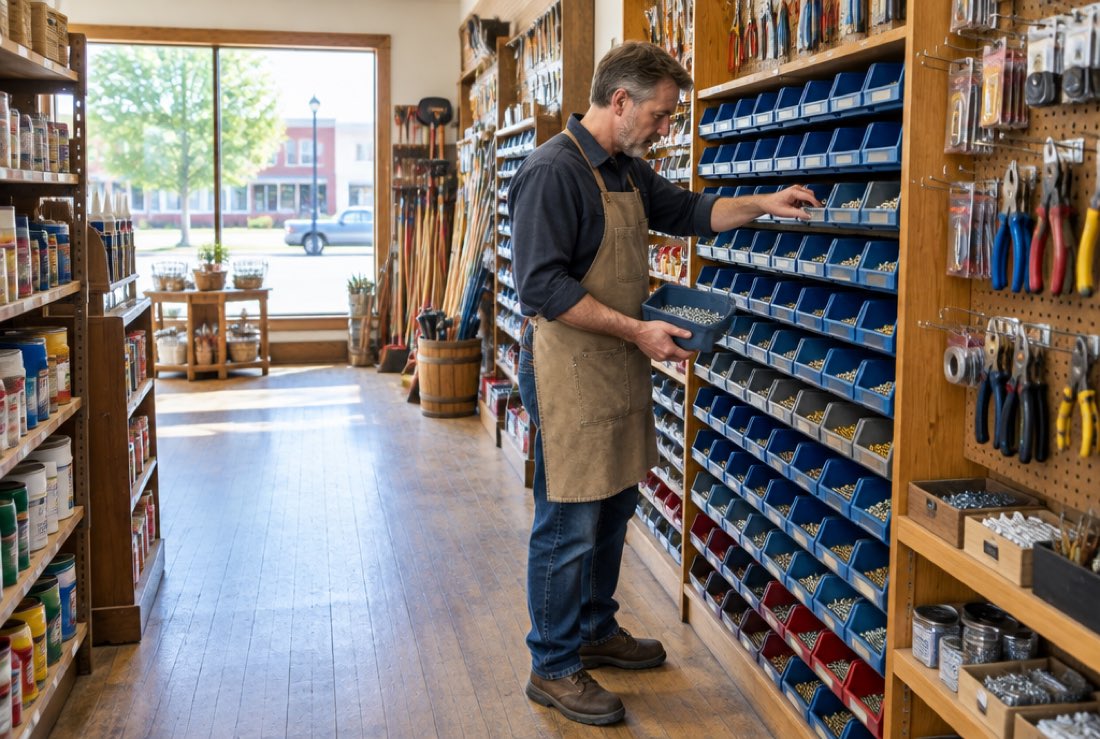
Two Rivers has run two stores for eleven years, four miles apart, and for ten of those years they behaved like two companies that happened to share a name.
Each store had its own buyer, its own supplier relationships, and its own sense of what was low. When Cedar Street sat on forty-one boxes of heat tape through a warm November, nobody at Grand Ave knew — they ordered their own, at their own case price, on their own lead time.
The call that never happened
In theory a buyer picks up the phone and asks the other store. In practice, Robin says, nobody does: "You would have to know to ask. That is the whole problem. Nobody calls about the thing they forgot."
Aisle checks the other store first. Before it writes a purchase order for a bin that has tripped its minimum, it looks at what the other location has above its own minimum, and if the math works it proposes a transfer instead.
The Tuesday run
Two Rivers already had a van going between the stores twice a week. Now it goes with a printed slip.
- The slip lists item, bin, and the count each store ends up with.
- Both counts update when the boxes are scanned in at the far end.
- If the surplus store drops under its own minimum first, Aisle stops proposing the move.
About one in six orders that Aisle would otherwise have written is now a transfer. Over a year that came to roughly $31,800 of stock moved rather than bought, most of it seasonal — heat tape, pipe insulation, rock salt, the things that are worth money for eight weeks.
What the buyer does now
The orders themselves go out at 4 PM every weekday, already approved, to four distributors in the formats each of them takes. Robin's buyer used to spend her mornings reconciling. She spends them on the floor.
The stores stopped being two stores. That is the part I did not expect from an inventory system.
Cobb Valley gets our orders at 4 PM every weekday without me touching them. My buyer spends her mornings on the floor again.